
What Is a Court Docket in Barry County
A docket is the official index of a case. It lists each event in date order, from the first filing to the final judgment. Every line, called a docket entry, marks one thing the court did or received. A single case can hold dozens of entries over its life. The docket does not carry the full text of each document. It records that the paper exists, the date it landed, and a short label for what it was.
In Barry County, dockets sit inside the statewide MiCOURT case-search system and the county trial-court pages. Michigan runs three trial courts, so a docket lives in whichever court owns the case. The county homepage gathers circuit, district, and probate lookups in one hub. The MiCOURT case-search home page is the shared entry point for all three court levels.
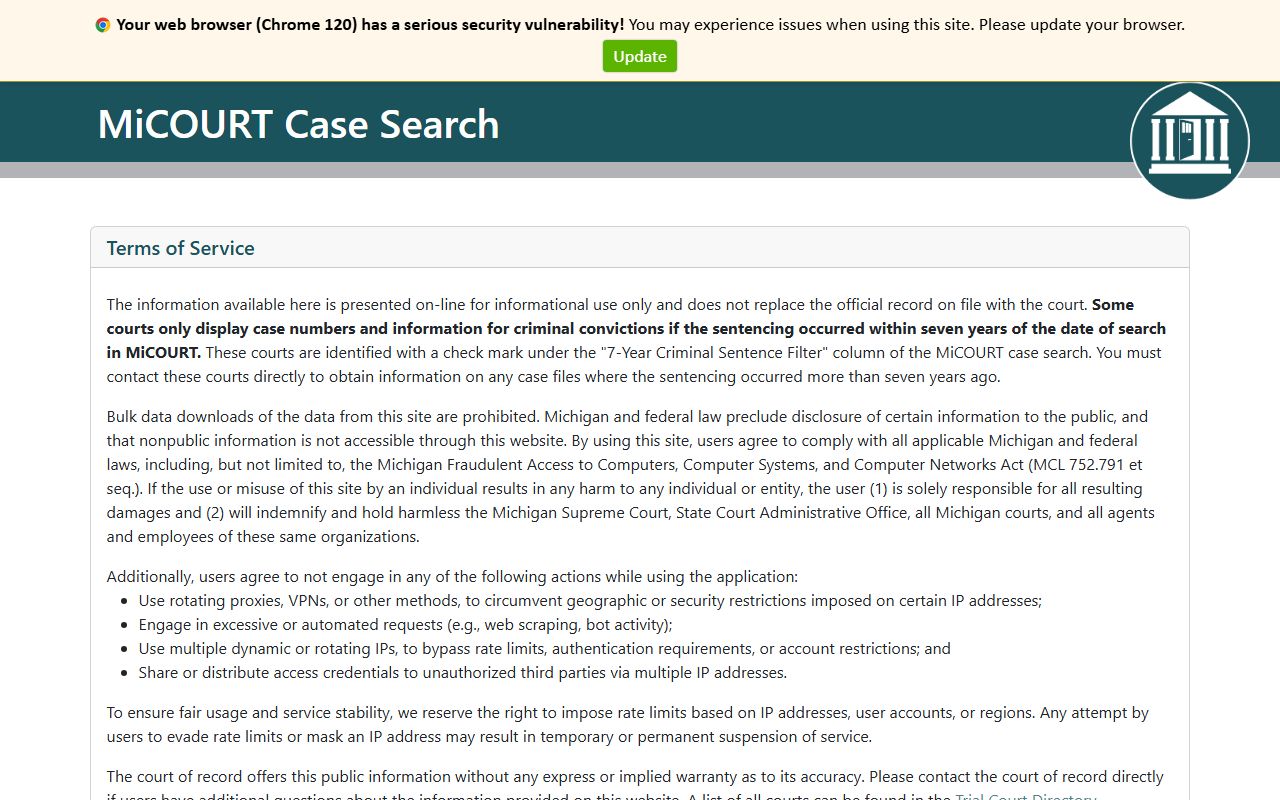
From that screen a reader picks a court and searches by case number or name to reach the docket for one matter.
Note: A docket line confirms that a filing exists and when it was entered, but the full document text usually lives in the court file rather than the online docket entry.
How to Search Barry County Court Dockets
The practical starting point is the county Case Lookup page, which routes to three separate portals rather than one universal search. For circuit, district, and probate matters, the county links straight into MiCOURT. Each portal takes a case number when you have one and a party name when you do not. You can also search by attorney name or by bar number to track counsel or a filer.
The county gathers those launch points on its Case Lookup page, which sorts the links by court level.
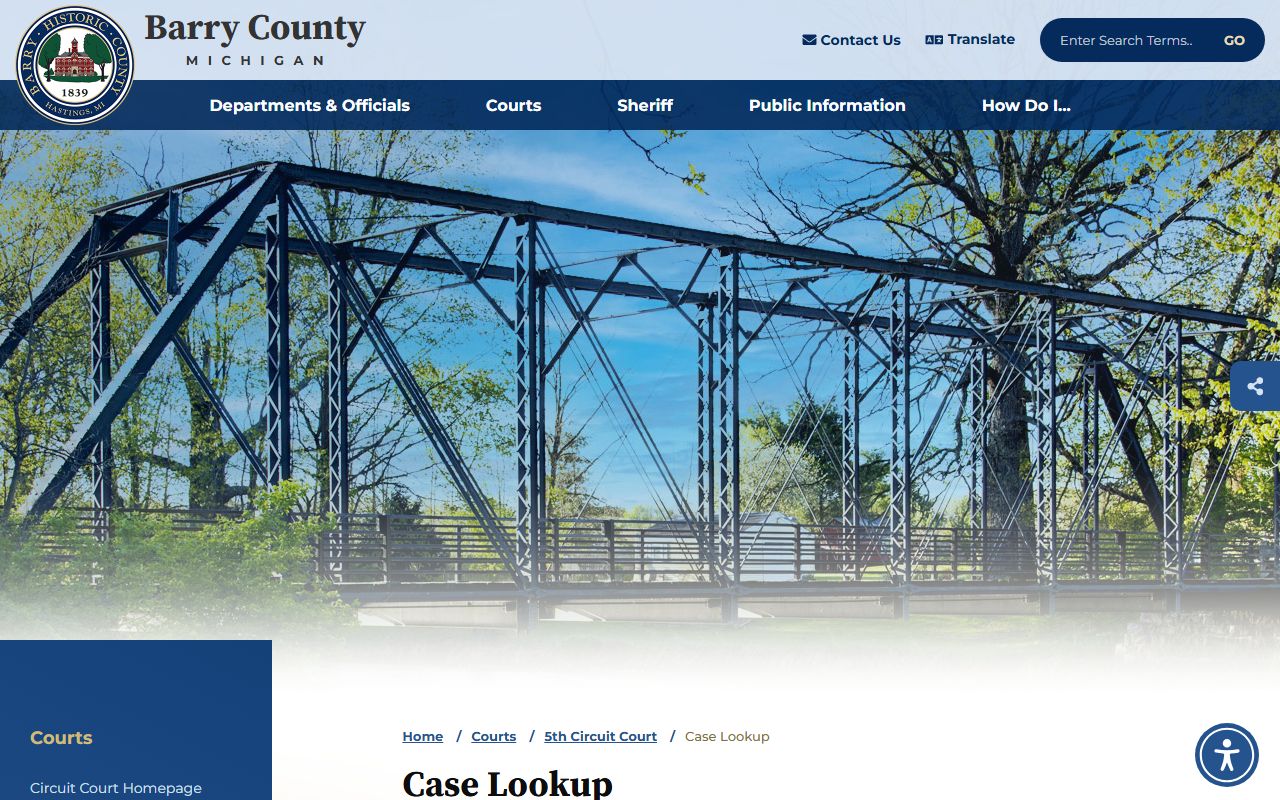
Those three buttons feed the same MiCOURT search but scope it to the right Barry County court. The steps below walk through a single docket lookup.
- Open the county Case Lookup page and choose circuit, district, or probate.
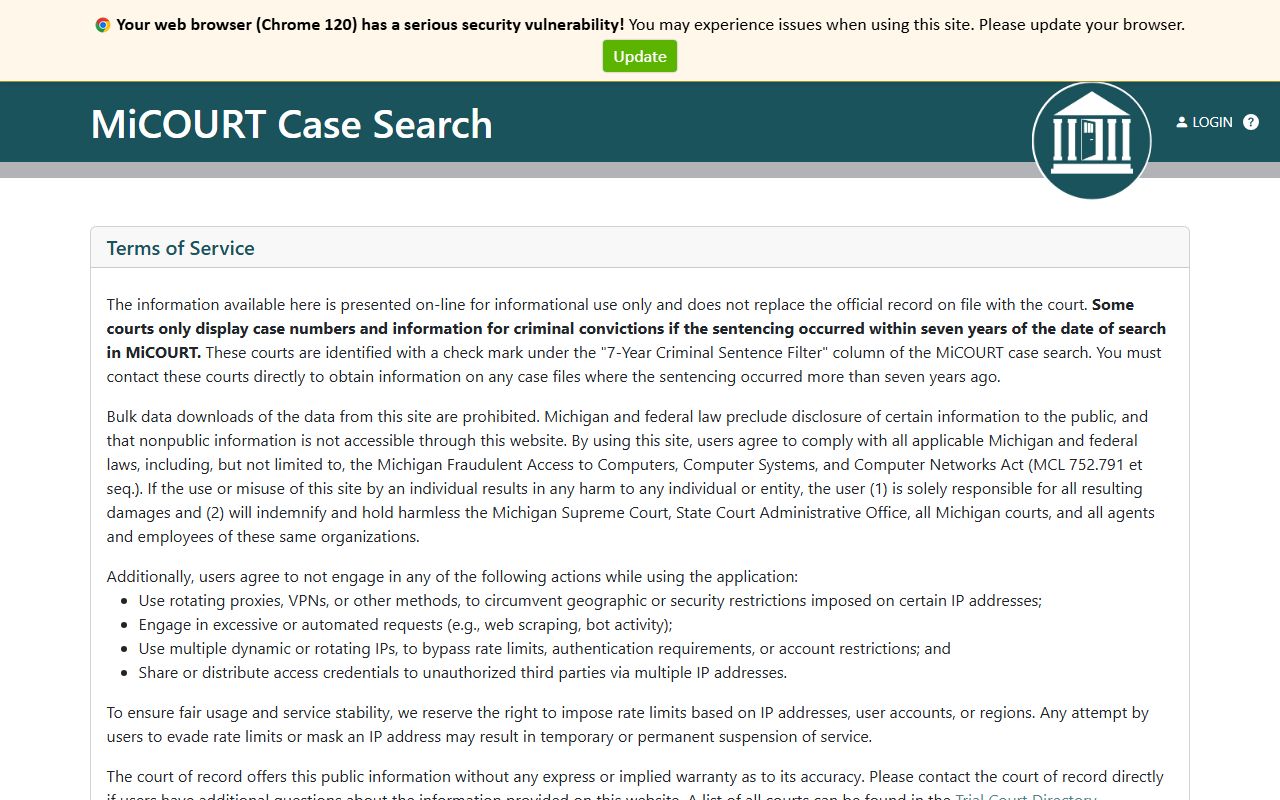
- Follow the link into MiCOURT for that court level. The circuit link opens a Terms page first, then the search screen.
- Enter a case number for a direct hit, or a party name to browse the list of matches.
- Switch to attorney name or bar number when you are tracking a lawyer or a repeat filer.
- Open the matching case and read its docket entries in date order.
What a Barry County Docket Entry Shows
Each docket line packs several fields into one row. Read together, the fields tell you who filed, when, and what the court did next. The table below breaks down the parts a reader will see on a Barry County case docket.
| Field | What It Shows |
|---|---|
| Case Number | The court-level code plus the case digits, such as C05 for circuit, D56B for district, or P08 for probate. |
| Entry Date | The date the court received or acted on the item. |
| Event Type | A short label for the filing or action, such as motion filed or order entered. |
| Filing Party | Which side filed the item, plaintiff or defendant, petitioner or respondent. |
| Judge or Magistrate | The judicial officer assigned to the case, where that is public. |
| Hearing Date | Any date set for a future hearing or conference. |
| Case Status | Whether the case is open, closed, or pending a ruling. |
Reading a Barry County Docket Line
Docket labels lean on legal shorthand. A few plain definitions clear up most of what a reader hits on a Barry County case. The terms below appear across circuit, district, and probate dockets alike.
- Docket entry
- One dated line recording a single filing or court action.
- Motion
- A request asking the judge for a ruling on a point in the case.
- Order
- A judge's or magistrate's written directive.
- Continuance
- A delay that moves a hearing to a later date.
- Disposition
- How the case ended or where it now stands.
- Judgment
- The final resolution the court records for the case.
Read the entries top to bottom to follow the case as it moved. The last few lines usually show the disposition, any judgment, and whether a party filed a notice of appeal.
Common Barry County Docket Entries
Most cases move through a familiar set of events, and the county's public record pages use the same core language readers see across Michigan. The list below covers the docket entries that show up most often, from the opening complaint to a default judgment. Each signals a distinct step in the case.
| Docket Entry | What It Signals |
|---|---|
| Complaint filed | A civil case opens when the plaintiff files the complaint. |
| Summons issued | The court issues notice for the other party to respond. |
| Answer filed | The defendant responds to the complaint. |
| Motion filed | A party asks the judge to rule on a point. |
| Order entered | The judge signs a directive in the case. |
| Hearing scheduled | A court date is set for argument or testimony. |
| Arraignment | A first criminal appearance where charges and bond are addressed. |
| Preliminary examination | A district-court hearing on felony probable cause. |
| Bindover | A felony transfers up to circuit court. |
| Sentencing | The court imposes a sentence after a plea or verdict. |
| Judgment entered | The court records the final resolution. |
| Notice of appeal | A party moves the case toward a higher court. |
| Continuance | A hearing is delayed or rescheduled. |
| Default judgment | One side wins because the other failed to respond. |
Circuit Court Dockets in Barry County
The 5th Judicial Circuit is Barry County's top trial court, and its dockets carry the heaviest matters. Felony files land here after bindover from district court, along with larger civil suits, domestic-relations cases, and appeals from the lower courts. In MiCOURT, the circuit uses court code C05, which shows in both the case number and the lookup address.
The county links the circuit lookup directly to the Barry County circuit case-search page, though the first click opens a MiCOURT Terms screen.
A circuit criminal docket runs from arraignment work through pretrial, plea or trial, and sentencing. A civil or domestic-relations docket runs from the complaint through motions, orders, and the final judgment. The full case file, motions, and transcripts sit with the court clerk and in the wider Barry County court records system rather than on the docket line itself.
District Court Dockets in Barry County
The 56-B District Court handles the county's high-volume lower docket. Its case list covers civil infractions, misdemeanors, traffic, small claims, and landlord-tenant matters, plus the arraignments and preliminary examinations that start felony cases. District cases use MiCOURT court code D56B.
The county's broader Search for page routes district, circuit, and probate record links alongside vital records and property tools.
A district criminal docket often moves fast, from arraignment to plea and sentence in a handful of entries. Traffic and small-claims dockets can close in a single hearing. When a felony starts in district court, the docket ends with a bindover entry that sends the case up to the circuit. Common district docket lines a reader will see include:
- Arraignment set and completed
- Pretrial conference scheduled
- Preliminary examination held or waived
- Plea entered and sentence imposed
- Civil-infraction or small-claims judgment entered
Probate Court Dockets in Barry County
Barry County Probate Court keeps its own dockets for estates, trusts, guardianships, conservatorships, and mental commitment proceedings. In MiCOURT the probate court carries code P08. The Barry County probate case-search page is the online launch point for these files.
A probate docket reads a little differently from a civil or criminal one. Instead of a complaint and answer, it opens with a petition and moves through letters, an inventory, accountings, and orders. Informal and formal probate follow different form and fee paths, so their dockets do not always match. Mental commitment matters are handled here too, and those records sit under tighter access limits than an ordinary estate file.
Note: Probate dockets show that a petition, inventory, or order was filed, but the underlying documents and sensitive commitment records often require a clerk visit or a formal request.
Barry County Court Schedules and Judge Displays
Beyond a single case lookup, the county posts daily hearing calendars through public judge-display links. Those pages show what each judge has set for the day, which helps when you want to watch a matter rather than track one case number. The displays cover circuit, district, probate, and family hearings.
The county keeps these links on its Court Schedules page, which carries an important access notice.
The schedule tools do not show everything on the calendar.
FOC and Family-Division Docketing in Barry County
Family cases run on a split track. The circuit Family Division handles divorce, custody, support, paternity, and parenting-time filings, while the Friend of the Court manages the support and order side once a case is under way. FOC becomes active after an action is filed and a judge signs an order, then it tracks child support, custody, parenting time, uninsured medical costs, and spousal support.
FOC records follow a different access path from a public docket. The county routes them through its FOC court-records page, which uses the FOC 72 request form.
A family-division docket in Barry County shows the public case events, but confidential FOC records cannot be released, and the FOC office reviews each request. That means the docket may confirm a hearing or an order while the sensitive support detail stays off the public view.
Docket vs. Full Case Record
A docket and a full case record are not the same thing, and the difference matters when you decide where to look. The docket is a map of events. The full record holds the documents behind those events. The comparison below lines up the two for a Barry County case.
| Docket | Full Case Record | |
|---|---|---|
| Format | Dated list of entries | Complete filings, motions, and orders |
| Access | Often online through MiCOURT | May need a clerk visit, fee, or request |
| Content | Event labels and dates | Full document text and exhibits |
| Best use | Track how a case moves | Legal review and certified copies |
When the docket is not enough, the county clerk holds circuit orders and certified copies, and older or non-digitized files often require a written request. For anything flagged non-public, the docket may be all the public view a reader gets.