
Criminal Court Records in Barry County
A criminal court record is the case file the court opens once a prosecutor files a charge. It is not the arrest report and it is not the jail booking sheet. It is the court's own running account of the matter: the charges as filed, the first court date, each plea and motion, every hearing, and the way the case finally ends. In Barry County the file lives with the court that handles the case, and most of it is open to the public. For a look at the charges by themselves, see the Barry County arrest and court charge records, and for the wider set of case types see the county court records overview.
Two trial courts produce these files. The 56-B District Court in Hastings handles misdemeanors, civil infractions, arraignments, and preliminary examinations, so nearly every criminal case begins there. Felony matters move up to the 5th Judicial Circuit Court after a district judge binds the case over. That split means a single serious case can leave a paper trail in both courts, and a full search sometimes has to check each one.
How to Search Barry County Criminal Court Records
The county routes public case lookups through MiCOURT, Michigan's statewide case-search system. The Barry County case lookup page gives three launch points, and criminal files sit under the district and circuit links. Barry County uses court code D56B for the district court and C05 for the circuit court, so a search can be pointed at the right court from the start.
- Open the county case lookup page and choose District Court for a misdemeanor or Circuit Court for a felony.
- The county link sends you into the MiCOURT case-search system, where the circuit link lands on a terms screen before the search opens.
- Search by the defendant's name when you do not have a number, or enter the case number for a direct hit.
- Open the case to read the docket, the charges, the hearing history, and the disposition.
- Ask the County Clerk for a certified copy when a court-stamped document is needed.
Older, sealed, or non-digitized files may not appear online. When that happens, the fallback is a written request to the clerk or a Michigan FOIA request, and the county's public schedule pages deliberately hide non-public cases. A statewide criminal-history check runs through the Michigan State Police rather than the county, so the court file and a formal background report are two separate things.
Stages of a Barry County Criminal Case
A criminal case moves through a fixed set of steps, and each step drops an entry into the record. The county's own criminal division FAQ walks through the early stages, from the first appearance to the felony preliminary examination. You can read the county explanation on the 56-B District Court criminal FAQ page.
That page confirms the local practice at arraignment: the court states the charges, tells the defendant whether the case is bond-eligible, and sets the bond amount. The case flow then reads: Charges Filed › Arraignment › Preliminary Exam › Bindover › Plea or Trial › Disposition › Sentencing. The preliminary exam and bindover steps apply to felonies, where the district court tests probable cause before the case can rise to the circuit court.
| Stage | What Happens |
|---|---|
| Arraignment | The first appearance. The court reads the charges, states bond eligibility, and sets the bond amount. |
| Preliminary Exam | A district-court hearing on felony probable cause, held before the case can leave the lower court. |
| Bindover | The district judge sends a felony up to the 5th Circuit Court for trial-level handling. |
| Plea or Trial | The defendant pleads guilty or no contest, or the case goes to a bench or jury trial. |
| Sentencing | After a plea or guilty verdict the judge imposes the sentence and any probation terms. |
Pretrial conferences and motions fall between arraignment and trial, and the docket logs each one. A defendant who misses a court date can trigger a bench warrant, which then becomes part of the file. For active orders of that kind, see the county warrant records guidance.
Note: A felony case can show entries in both the district and circuit files, so checking one court alone may miss part of the story.
What a Barry County Criminal Court Record Shows
The visible fields in a Michigan criminal file are consistent across courts. A reader will see who was charged, what they were charged with, how each charge moved, and how the case closed. The table below breaks down the core fields and what each one tells you.
| Field | What It Shows |
|---|---|
| Case Number | The court's file number, carrying the D56B or C05 court code that marks the district or circuit court. |
| Defendant | The person charged, plus attorney of record when one is listed. |
| Charges | Each count as filed, with the offense and its level as a misdemeanor or felony. |
| Docket Entries | Dated events: arraignment, motions, hearings, preliminary exam, bindover, and orders. |
| Plea | Guilty, not guilty, or no contest, recorded for each count. |
| Disposition | How the case ended: conviction, dismissal, acquittal, or a deferred outcome. |
| Sentence | Jail or prison time, fines, restitution, and any probation conditions. |
Some fields stay blank or hidden. Judge assignments show where they are public, and payment entries appear when the case carries fines or costs. Personal identifiers such as Social Security numbers are redacted under court rule.
Charges vs. Convictions in Barry County Records
Being charged is not the same as being convicted, and a criminal court record shows both. A file can list charges that were later dropped, dismissed, reduced, or that ended in acquittal at trial. Reading the disposition line matters more than reading the charge line, because the disposition is what actually happened.
| Charge | Conviction | |
|---|---|---|
| Stage | Accusation filed by the prosecutor | Guilty verdict or plea |
| Burden of Proof | Probable cause | Beyond a reasonable doubt |
| Can Change To | Dropped, dismissed, or reduced | Final unless appealed |
| Public Record | Yes | Yes |
Because a charge alone does not prove wrongdoing, the record should be read all the way to the end before drawing any conclusion. A closer look at how charges are filed and amended lives on the arrest and court charge records page.
Prosecutor and Public Defender Roles
Two offices shape almost every criminal file. The Barry County Prosecuting Attorney decides what to charge and carries the case in court, while the Public Defender represents defendants who cannot afford a lawyer. Julie A. Nakfoor Pratt is the Prosecuting Attorney, working with Chief Assistant Prosecutor David G. Banister and a small team of assistants. The office is detailed on the county prosecuting attorney page.
The prosecutor handles state-law and county-ordinance violations, juvenile neglect and delinquency, probate mental-health petitions, and paternity and support matters. The office works out of Ste. 201 in the Courts and Law Building at 206 W. Court St. and can be reached at 269-945-1297. Its charging decisions are the first entries that give a criminal file its shape.
On the other side sits Chief Public Defender Kerri L. Selleck, whose office assigns counsel to indigent adults facing criminal charges. The office also appears at arraignment to request a reasonable bond for a defendant who cannot afford one. Its staff and contact details are posted on the county public defender page.
The public defender works from Ste. 101 in the same building and answers at 269-818-0379. When the record shows a defense attorney of record, it is often this office. The bond arguments both sides make at arraignment shape the early docket entries a reader sees.
Reading Barry County Dispositions and Sentences
The disposition line closes the loop on a case. Common outcomes include guilty, not guilty, dismissed, and no contest, along with deferred arrangements that hold judgment while a defendant completes conditions. A sentence entry then spells out the penalty, which can combine jail or prison time, fines, restitution to victims, and probation.
Terms in a disposition:
- Disposition
- How the case ended or where it stands.
- No contest
- A plea that accepts the penalty without admitting guilt.
- Restitution
- Money the defendant pays back to a victim.
- Probation
- Supervised release with conditions in place of, or after, jail.
Probation is a frequent sentence. The 56-B District Court runs its own probation program with conditions posted on the district court probation page, while the circuit court oversees adult probation for felony cases. Some defendants are routed into a specialty court instead of standard supervision.
Specialty Courts and Probation
Barry County runs three adult specialty court programs, and a defendant's file may show placement in one of them. These are treatment-focused tracks that swap intensive monitoring for a straight jail sentence, and each has its own conditions, phases, and drug-testing rules.
- 56-B District Sobriety Court, a misdemeanor probation track for addicted or abusing probationers who need close supervision.
- 5th Circuit Adult Drug Court, a four-phase felony treatment track for higher-level cases.
- 5th Circuit Swift and Sure Sanctions Probation Program, launched in January 2012 for felons who would otherwise face prison.
The county describes each program on its adult specialty courts overview. When a case runs through one of these tracks, the docket logs the placement, the phase progress, and any sanctions, so the record reflects a very different path than a standard sentence.
Sealed vs. Expunged Records
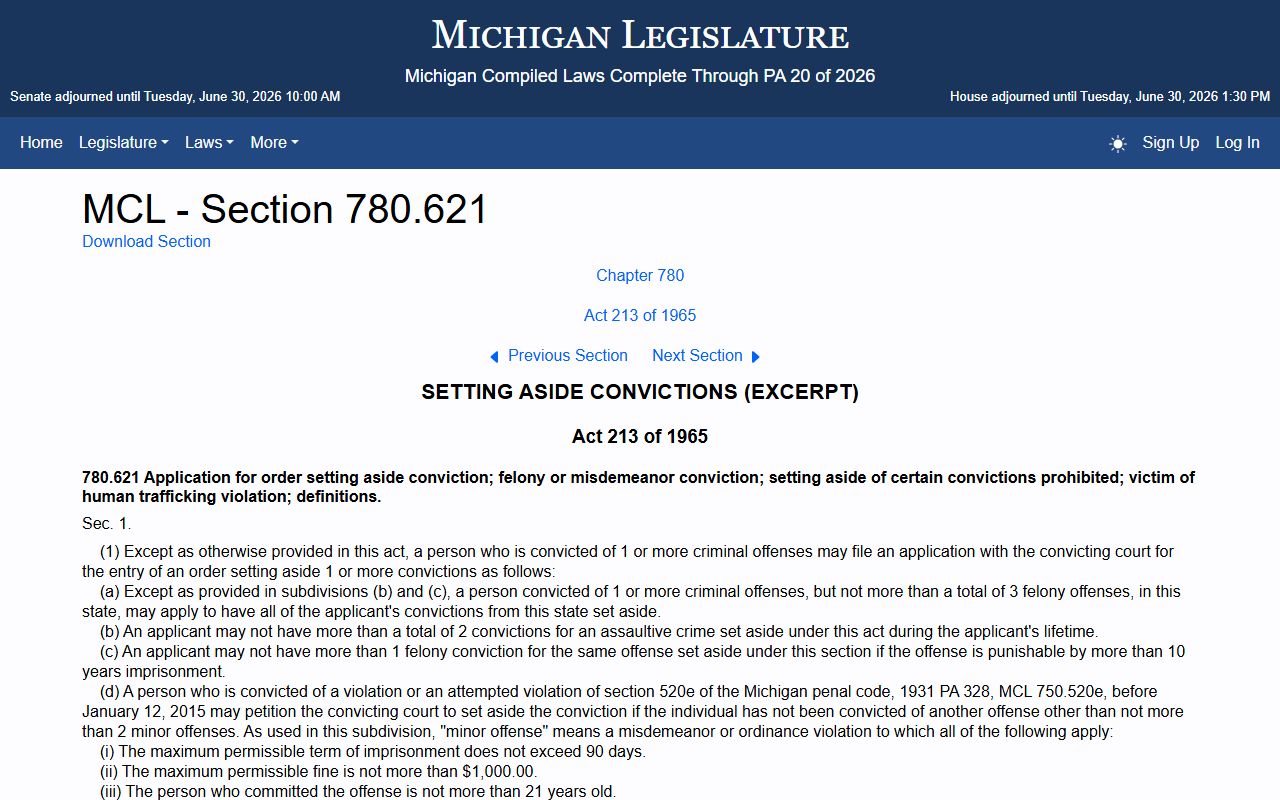
Not every criminal record stays open forever. Michigan lets qualifying convictions be set aside, and the terms sealed and expunged get used loosely, so it helps to keep them apart. A sealed record is hidden from ordinary public view but still exists, while an expunged, or set-aside, conviction is treated as though it never happened for most purposes. The controlling law is Michigan's set-aside statute, shown on the state legislature site.
The full text of the set-aside statute is published at MCL 780.621 on the Michigan Legislature website.
| Sealed | Expunged (Set Aside) | |
|---|---|---|
| Visibility | Hidden from public search | Treated as though the conviction never occurred |
| Law Enforcement | Limited access remains | Very limited, kept in a nonpublic file |
| Michigan Authority | Court rule and case-specific orders | MCL 780.621; traffic offenses under MCL 780.621c |
| Record Erased | No | Set aside, not physically destroyed |
Eligibility depends on the offense, the waiting period, and prior history, and traffic convictions follow a separate set-aside path. A granted set-aside does not erase the file from existence; it removes the conviction from public reach.
Public Access to Barry County Criminal Court Records
Michigan treats court proceedings as open by default, and criminal case files are largely public. Two systems govern access at once: the state's open-records law and the court rules that control record files. Together they set what a member of the public can see and what stays closed.
Key Statutes:
MCL 600.1420 - Michigan courts sit publicly, so hearings and their records are open except where a statute closes them.
MCL 15.231 - The Michigan Freedom of Information Act presumes public records are open unless a specific exemption applies.
Court files carry an added layer under Michigan Court Rule 8.119, which governs how trial courts keep and release their records. In practice this means the MiCOURT search and the clerk's counter are the public front doors, while non-public and confidential matters are filtered out before display.
Background Check Considerations
A criminal court lookup is not the same as a regulated background check. Reading a file through MiCOURT is fine for personal knowledge, but any report used for hiring, housing, credit, or insurance must follow the federal Fair Credit Reporting Act. Those decisions call for a licensed screening agency and a verified statewide criminal-history report, not a casual court search.
Important: This site is not a consumer reporting agency under the FCRA, and its information cannot be used for employment, tenant, credit, or insurance screening.
Restricted Barry County Criminal Court Records
Some criminal matters never reach the public search. Juvenile cases are the clearest example. Michigan keeps juvenile records under strong confidentiality limits, and many are open only by court order.
The juvenile confidentiality rule sits at MCL 712A.28, which keeps juvenile files closed to normal public access. Sealed and set-aside convictions drop out of the public index as well, and adoption and mental-commitment matters are handled outside the ordinary criminal search. Ongoing cases flagged non-public are held back from the county schedule pages until the court lifts the restriction.
Note: When a file will not load online, a written request to the clerk or a Michigan FOIA request is the standard path to a restricted or non-digitized record.