
How to Search Barry County Traffic Court Records
Barry County traffic cases are filed in the 56-B District Court, so the court case file is the record you want. The state runs the search tool through MiCOURT for district court code D56B, which lists open and closed cases along with each disposition. The county also gathers its record links on the county case lookup page, which routes district, circuit, and probate searches to the right place.
Have a few details ready before you start. A citation number pulls one exact ticket. A full name plus a date of birth helps when you do not have the ticket in hand. Case status, hearing dates, and the fine amount all appear once you open the file.
- Open the MiCOURT case search for the 56-B District Court.
- Enter the citation or case number, or type the driver's full name.
- Narrow the results by filing date or case type if the list is long.
- Open the case to read the charge, the court date, and the disposition.
- Pay the fine, request a hearing, or ask the clerk for a certified copy.
Which Court Handles Barry County Traffic Cases
Nearly every traffic matter in the county runs through the 56-B District Court. This court hears civil infractions, such as speeding or a rolled stop sign, and it hears misdemeanor traffic citations. The county explains the ticket process on its district court tickets and citations page, which also posts the local fine schedule.
The county lays out the payment rules and hearing options in a clear format on that same site.
The court publishes its ticket and fine details on the 56-B District Court citation page.
That page confirms which fines apply and how the court wants payment or a hearing request delivered.
206 W. Court St., Ste. 202
Hastings, MI 49058
Phone: 269-945-1404
Court hours: Monday to Friday, 8:00 a.m. to 5:00 p.m.
GovPayNow pay location code: 1032
Types of Traffic Cases on Record
Traffic files in Barry County fall into a handful of groups. Civil infractions carry a fine and points but no jail time. Misdemeanor traffic charges are heavier and can bring probation or jail. Parking tickets, equipment problems, and commercial vehicle stops each leave their own kind of record.
- Civil infractions - moving violations like speeding, failure to yield, or running a light, resolved by fine and points.
- Misdemeanor traffic - more serious driving charges that can carry probation or jail on top of a fine.
- Parking violations - improper parking, posted-hours parking, and handicapped-space parking cases.
- Equipment violations - defective equipment tickets tied to lights, brakes, or other required parts.
- Commercial and CDL cases - stops involving commercial drivers, which follow tighter reporting rules.
What Barry County Traffic Court Records Show
A traffic case file holds the facts of the ticket and how the court closed it. The record ties a citation number to a driver, a charge, a court date, and a result. Each field tells part of the story, and the fine and point entries matter most for what the state does next.
| Field | What It Shows |
|---|---|
| Citation Number | The unique number the officer wrote on the ticket, used to pull one case. |
| Charge / Statute | The violation cited, such as careless driving or disregard of a stop sign. |
| Court Date | The date set for payment, a hearing, or an appearance in the 56-B District Court. |
| Disposition | How the case ended, such as admitted, dismissed, or found responsible. |
| Fine Amount | The civil fine and costs owed, drawn from the county fine schedule. |
| Abstract Status | Whether the conviction was sent to the Secretary of State for the driver record. |
Searching by Citation Number vs by Name
The way you search shapes what you get back. A citation number points to one exact ticket and skips the guesswork. It is the fastest path when you hold the paper ticket or a court notice. Type the number just as it prints, since a small error can return no match.
A name search helps when the ticket is lost or you look up a case for someone else. Add a date of birth to trim a long list of common names. Keep in mind that a name search can surface more than one driver, so confirm the case belongs to the right person before you pay or act on it.
Note: A wrong citation format is the most common reason a valid ticket returns no result, so recheck the number before you assume the case is closed.
How to Pay or Contest a Barry County Traffic Ticket
The county splits the ticket process into two paths: pay it or fight it. The county traffic ticket page spells out the payment types and the hearing rules. You can pay in person, by mail, by phone, or online with a card.
The county walks drivers through the whole payment and hearing choice on its pay a traffic ticket page.
That page lists the accepted payment types and the deadline that decides whether a mailed appearance counts.
Cash is accepted in person only. Cashier's checks and money orders work by mail or in person, and money orders must be payable to the 56-B District Court. Card payments run by phone or through GovPayNow with pay location code 1032. When you deny the ticket, tell the court in person, in writing, or by phone, then choose an informal or a formal hearing.
- Read the citation and confirm whether it is a civil infraction or a misdemeanor.
- To pay, choose in person, mail, a phone card payment, or an online card payment.
- For a mailed admission, include a signed admission of responsibility and full payment.
- Make sure the court receives that mailed appearance within 14 days, since the postmark sets the date.
- To contest, notify the court in person, in writing, or by phone and ask for a hearing.
- Decide between an informal hearing and a formal hearing, then keep the citation for your records.
Informal Hearings vs Formal Hearings
When you deny a civil infraction, the court offers two hearing types. An informal hearing is heard by a district court magistrate. No prosecutor takes part, and no defense attorney appears. You, the officer, and the magistrate talk through the ticket, and the magistrate decides.
A formal hearing is heard by a district court judge, and a prosecutor is present. You may hire an attorney to represent you at this type of hearing. The formal path adds more process, so many drivers pick it only when the stakes or the facts call for it.
Admit, admit with explanation, or deny: The county lets a driver admit responsibility, admit with an explanation, or deny responsibility and request a hearing. Choosing to admit with an explanation still means responsibility is admitted, though the court can weigh the reason when it sets the fine.
Court Traffic Records vs State Driver Records
This is the split that trips up most drivers. The court traffic record is the local case file held by the 56-B District Court. The state driver record is a separate history kept by the Michigan Secretary of State. One shows the case; the other shows the license and the point total across time.
The Michigan Secretary of State posts the driving record details on its official driving record page.
That page shows how the state record differs from the court file a driver pulls from the 56-B District Court.
| Court Traffic Record | State Driver Record | |
|---|---|---|
| Record Source | 56-B District Court | Michigan Secretary of State |
| What It Shows | Citation, hearing, and case disposition | License status, convictions, and points |
| Where to Access | MiCOURT D56B or the court clerk | State driving record online or by mail |
| How to Correct Errors | Contact the 56-B District Court clerk | Contact the Secretary of State |
The Michigan Secretary of State Driving Record
The state driving record is the file most employers and insurers ask for. It groups data into a header, a status block, and a driving history body that lists convictions, sanctions, and abstracts. The Secretary of State explains what the file holds on its driver and vehicle records FAQ.
The state describes how it sells and releases these records on its record sales page for communities and businesses.
That page confirms the mail search fee and the certified record cost noted below.
A driving record ordered online costs $16. A mail request runs $15 per record search, and a certified record costs $16. The record header lists the fields shown in the table below, and each one helps confirm the record belongs to the right driver.
| Field Label | Type | Required | Notes / Format |
|---|---|---|---|
| Driver's license number | Text | Yes | Part of the license header. |
| Full name | Text | Yes | Driver record header. |
| Date of birth | Date | Yes | Driver record header. |
| Sex | Text | Yes | Header field. |
| Eye color | Text | Yes | Header field. |
| Height | Text | Yes | Header field. |
| Weight | Text | Yes | Header field. |
| Residence address | Text | Yes | Header field. |
| Mailing address | Text | Yes | Header field. |
| License type / credential | Text | Yes | Operator, CLP, TIP, and similar. |
| Previous / AKA names | Text | No | May appear in the header. |
| Status | Text | Yes | Suspended, revoked, valid, and so on. |
| Driving history / body | Report section | Yes | Convictions, sanctions, and abstracts. |
The Secretary of State posts the full FAQ on its driver and vehicle records page.
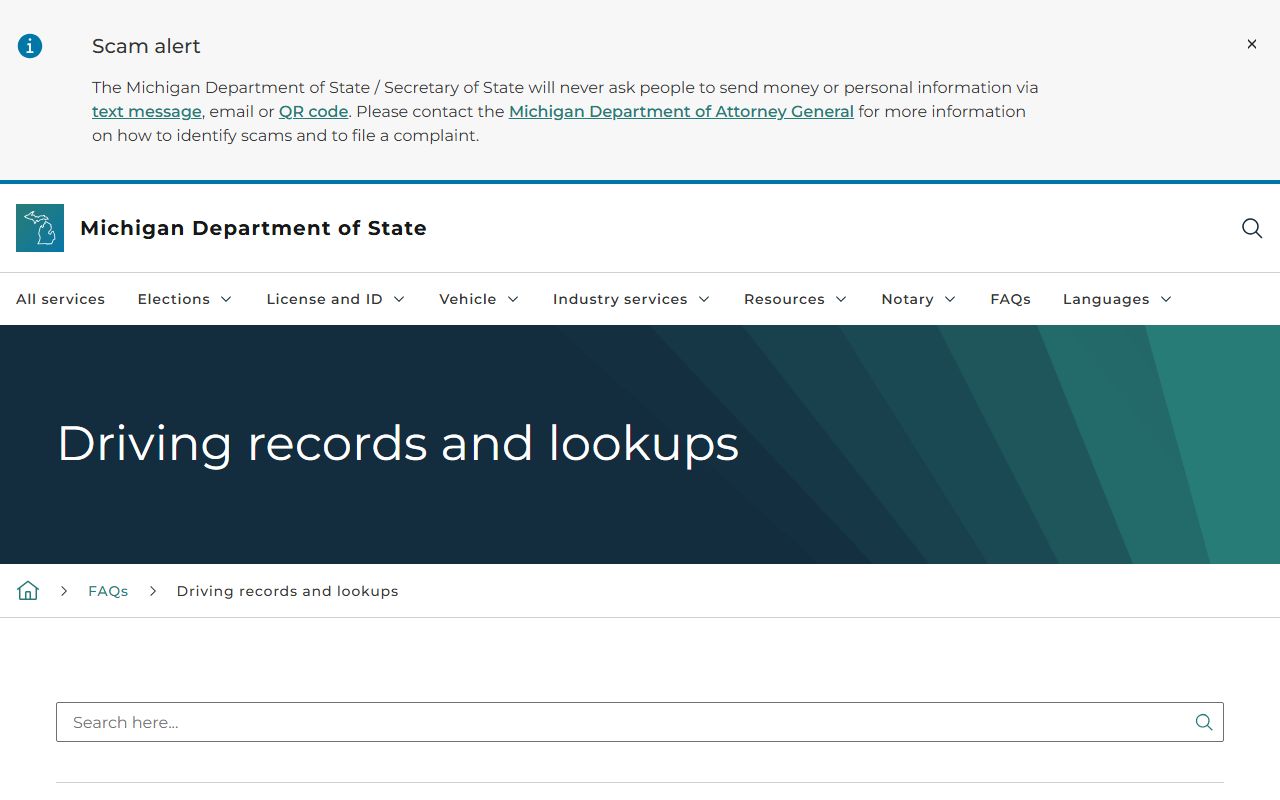
That FAQ lays out who may buy a record and how the state protects the personal fields in it.
Commercial drivers face tighter rules than other drivers. A CDL conviction can hit a career, so the state driver record carries added weight for anyone who drives for work. The Michigan driving record covers licensed drivers, unlicensed drivers, and out-of-state drivers convicted of traffic violations in Michigan.
That last point matters for visitors. A driver from another state who is cited in Barry County still generates a Michigan record for that conviction. The court sends the conviction to the Secretary of State, and the driver's home state may then pick it up through interstate sharing. Commercial and out-of-state drivers should confirm both the court file and the state record, since the two can update on different schedules.
Public Access and Abstracts to the Secretary of State
Michigan court records are public by default, with limits set by court rule and statute. The state's open records law, MCL 15.231, treats public records as open unless an exemption applies. Courts also sit publicly under MCL 600.1420, which keeps most hearings open to the public.
The link between the court file and the state record runs through an abstract. When a driver is convicted of a covered violation, the court sends an abstract to the Secretary of State, as set out in MCL 257.732. That transfer is how points and convictions move from the 56-B District Court onto the state driving record.
Key Statutes:
MCL 15.231 - Michigan FOIA presumes public records are open unless an exemption applies.
MCL 257.732 - Courts send traffic conviction abstracts to the Secretary of State.
DUI and DWI Cases
Drunk and drugged driving cases do not stay on the civil traffic track. Some DUI and DWI matters route into the criminal side rather than the civil infraction stack. That means an arraignment, possible probation, and a heavier record than a simple ticket produces.
For the full case file, charges, and sentencing on an impaired driving matter, see the Barry County criminal court records. General filings and copies for any case type sit under Barry County court records.
Setting Aside a Barry County Traffic Conviction
Michigan lets some people clear a past conviction through a set-aside, sometimes called an expungement. The general set-aside law is MCL 780.621. Traffic offenses follow their own separate rules, so a driver should not assume one path fits every conviction.
The traffic set-aside rules appear in MCL 780.621c.
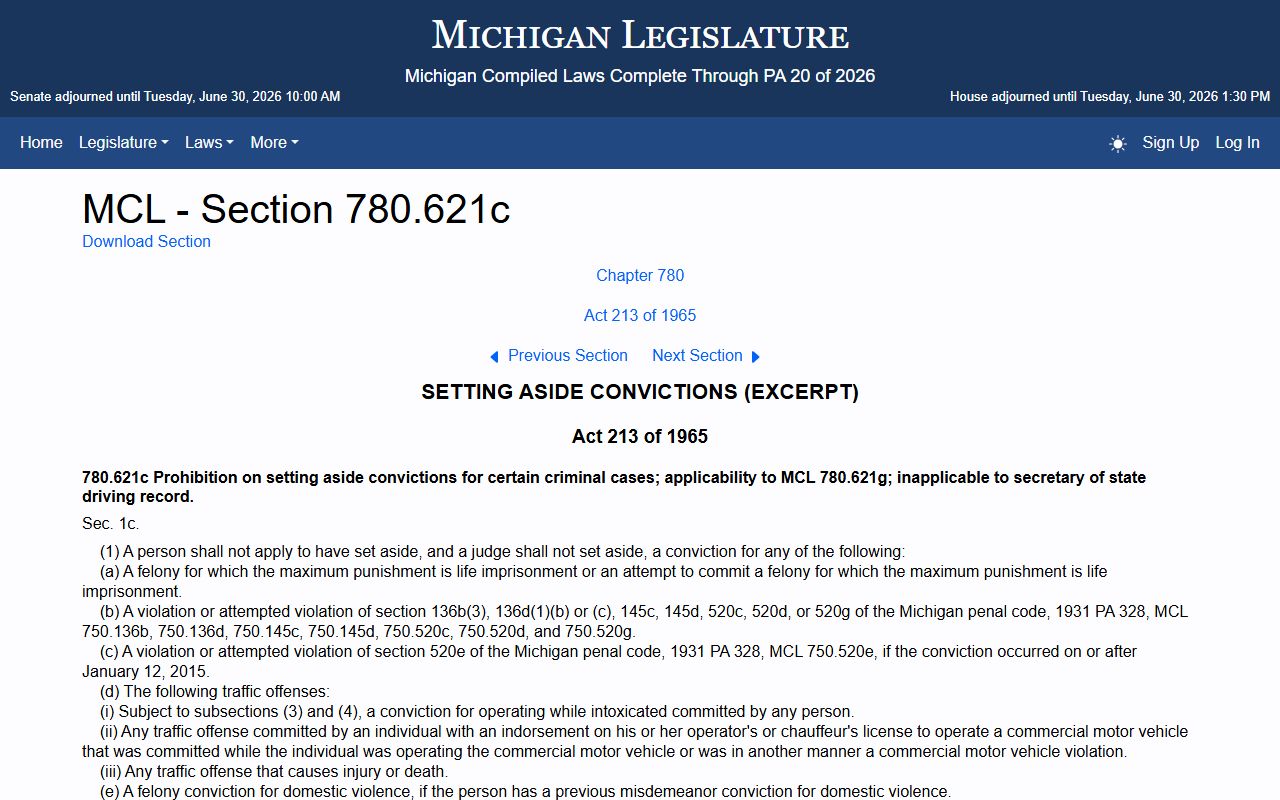
That statute page sets out which traffic convictions qualify and the limits that apply to them.
A set-aside does not erase the file from existence. The court hides the conviction from normal public access, but law enforcement may still reach it. Confirm the offense qualifies, check the waiting period, file in the right court, and pay the fee unless it is waived.
Note: A traffic set-aside follows different eligibility rules than a criminal set-aside, so confirm your conviction type before you file anything with the court.
Barry County Traffic Fines and Record Fees
The county posts a fixed fine schedule for common tickets, and the Secretary of State charges its own fees for a driving record. The table below combines the county civil fines with the state record costs so drivers can plan a payment. Fines can rise when a violation involves an accident.
| Item | Amount |
|---|---|
| Improper parking | $60 |
| Failure to pay parking ticket | $50 |
| Parking in violation of posted hours | $70 |
| Handicapped parking violation (civil) | $200 |
| Careless driving | $200 |
| Careless driving with accident | $250 |
| Defective equipment | $75 |
| Disregard stop sign | $100 |
| Disregard traffic light | $100 |
| Exhibition driving | $110 |
| Fail to yield | $100 |
| Fail to change address | $95 |
| Driving record online (Secretary of State) | $16 |
| Driving record mail search (Secretary of State) | $15 |
| Certified driving record (Secretary of State) | $16 |
Pay a court fine through the county online payments page or in person at the 56-B District Court during court hours.