
How to Search Barry County Court Records
Barry County does not run one universal case portal. Instead, the county's Case Lookup page acts as a launch hub with three direct buttons: Circuit Court Case Lookup, District Court Case Lookup, and Probate Court Case Lookup. Each button opens the statewide MiCOURT case-search system at micourt.courts.michigan.gov. MiCOURT tags each Barry County court with a short code. Those codes are C05 for the 5th Judicial Circuit Court, D56B for the 56-B District Court, and P08 for the Probate Court. The county links each code directly, so a search lands on the right court rather than a blank statewide screen.
The county collects those lookup links, judge schedules, and payment tools on its Trial Court landing page.
That page is the fastest way to reach the Case Lookup hub and confirm which court holds the file you need.
Before you start, gather what you know about the case. A case number gives the cleanest result. A party name works when you do not have the number. You can also search by attorney name or bar number when you are tracking counsel. One quirk is worth knowing. The circuit lookup opens first on a MiCOURT Terms screen, so the link lands on a terms page before it reaches the case search itself.
- Open the County Case Lookup page and pick Circuit Court, District Court, or Probate Court.
- Follow the link into MiCOURT for the matching court code, C05, D56B, or P08.
- On the circuit link, accept the MiCOURT Terms screen to reach the search fields.
- Enter a case number for a direct hit, or a party, attorney, or bar-number search when you do not have one.
- Open the case to read the docket, then use the clerk or the Friend of the Court for older, certified, or non-public material.
Barry County Court Records Search Fields
MiCOURT presents a small set of search controls that stay the same across the circuit, district, and probate lookups. You do not need every field. One good entry, such as a case number or a full party name, is usually enough to return a match. The table below lists the fields captured from the state court-search system and county link routing.
| Field Label | Type | Required | Notes / Format |
|---|---|---|---|
| Case Number | Text | Optional | Used for direct case lookup. |
| Party Name | Text | Optional | Search by a person or business name. |
| Attorney Name | Text | Optional | Search by attorney of record. |
| Bar Number | Text | Optional | Attorney bar-number search. |
| Appellate Court | Selector | Optional | Court-level filter shown in the search tool. |
| Lower Court | Selector | Optional | Court-level filter shown in the search tool. |
| Advanced Search | Button / tab | Optional | Opens added search options. |
| Submit Search | Button | Yes | Runs the search once fields are set. |
Note: Some non-public cases are hidden from the schedule and display tools, so a clean search can still miss a restricted file.
More Ways to Access Barry County Court Records
MiCOURT is the main path, but it is not the only one. The county's "Search for" page routes visitors to Birth, Death, and Marriage Records, FOC Court Records, Circuit Court Records, District Court Records, Probate Court Records, Real Estate Documents, County Maps and Tax Assessment Data, and Property Info and Maps. That hub is useful when you are not sure which office holds the file. Friend of the Court records follow their own track. FOC child-support and related family-court records are requested through FOC Form 72, which the FOC administrator reviews, and confidential FOC records cannot be released.
The county explains the FOC request path on its court-records access page, which links the FOC Form 72.
When you need a word-for-word account of a hearing, the county routes transcript orders by judge through a separate request page rather than the case lookup.
Fees and copies use different tools again. The county's online payments page handles district court, circuit court costs and fines, filing and motion fees, and family-court and probate fee buckets. It is a payment tool, not a search tool, so it is the place to settle a balance once you already have the case. Civil filers in the 56-B District Court e-file through MiFILE, which uses an e-filing account and prepaid fees rather than a public record viewer.
The county describes the payment buckets on its online payments page.
Those buckets cover fines and fees only, so treat the page as billing and use MiCOURT to find the case itself.
For civil e-filing, the county publishes its MiFILE page for the 56-B District Court.
MiFILE opens the door to file and pay online, but the finished filings still surface for the public through the MiCOURT case search.
When none of the online tools reach a record, two fallbacks remain. The County Clerk is the counter for court orders, older files, and certified copies that the search portals do not expose. A written records request or a FOIA request handles files that are older, non-public in part, or simply not digitized.
Types of Barry County Court Records
Which court holds a record depends on the kind of case. The 5th Judicial Circuit Court handles felony matters, larger civil cases, domestic relations, and appeals from the lower court. The 56-B District Court handles misdemeanors, traffic and civil infractions, small claims, and landlord-tenant files. The Probate Court handles estates, guardianships, conservatorships, and mental commitment proceedings. The Friend of the Court holds child-support and related family-court records under separate rules.
Michigan's court structure sorts these files into the same trial-court tiers used statewide.
The state describes those tiers on the Michigan Courts trial-courts overview.
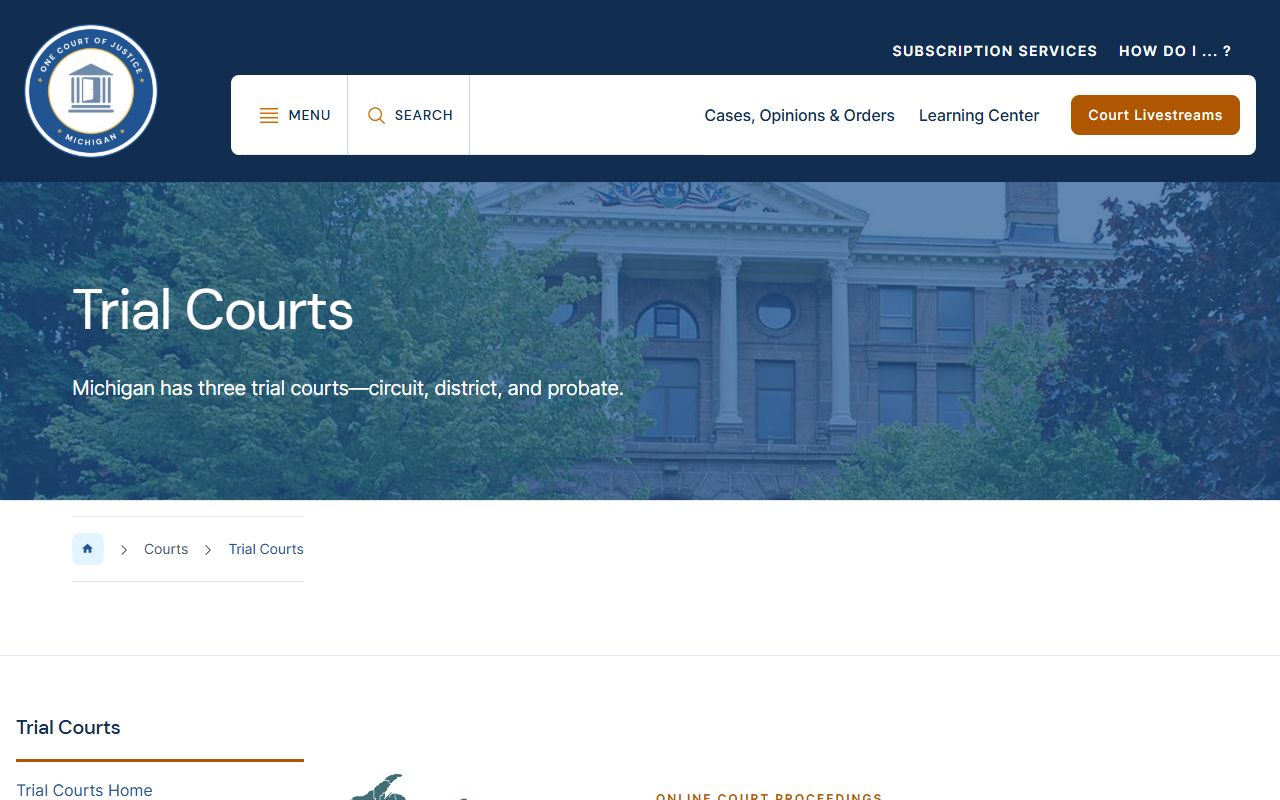
That overview confirms the circuit, district, and probate split that shapes every Barry County record search.
- Civil records: complaints, answers, motions, orders, judgments, and hearing notices in circuit or district court.
- Criminal records: arraignments, pleas, preliminary exams, bindovers, and sentencing across district and circuit court.
- Family records: divorce, custody, support, paternity, parenting time, and adoption matters.
- Probate records: wills, inventories, letters, orders, and guardianship or conservatorship filings.
- Traffic and small-claims records: civil infractions, misdemeanor traffic, and lower-value money disputes in district court.
What Barry County Court Records Show
A case opened in Barry County shows the same core structure readers see across Michigan. The record ties a case number to the parties, the assigned court, and a running list of docket events. The county's court codes appear right in the file, since C05, D56B, and P08 mark whether a matter sits in circuit, district, or probate. The table below lists the typical visible fields a public search returns.
| Field | What It Shows |
|---|---|
| Case Number | The unique file identifier, tied to a court code such as C05, D56B, or P08. |
| Party Names | The people or businesses named as plaintiff, defendant, petitioner, or respondent. |
| Attorney of Record | Counsel listed for a party, where the case shows one. |
| Filing Date | When the case opened with the court. |
| Court and Code | The court name and its level, circuit, district, or probate. |
| Judge or Magistrate | The judicial officer assigned, where that assignment is public. |
| Hearing Dates | Scheduled and past court dates for the matter. |
| Case Status | Whether the case is open, closed, or otherwise pending. |
| Docket Entries | The running log of filings and events, such as motions and orders. |
| Orders and Judgments | Rulings entered by the court and the final judgment. |
| Fee Entries | Payment or fee lines where the case displays them. |
Docket language stays consistent as well. You will see phrases such as complaint filed, summons issued, answer filed, motion filed, order entered, arraignment, preliminary examination, bindover, sentencing, and judgment entered. Reading the docket in order shows how a case moved from filing to disposition.
Public Access Laws for Barry County Court Records
Michigan treats court files as presumptively open, with defined exceptions. The state Freedom of Information Act at MCL 15.231 sets the policy that public records are open unless an exemption applies. Court access, though, runs on court rule as much as on ordinary open-records law. MCR 8.119 governs how trial courts keep and release their records, so a court file is controlled by that rule, not by county FOIA alone.
The state publishes those court-record rules through the Michigan Court Rules book.
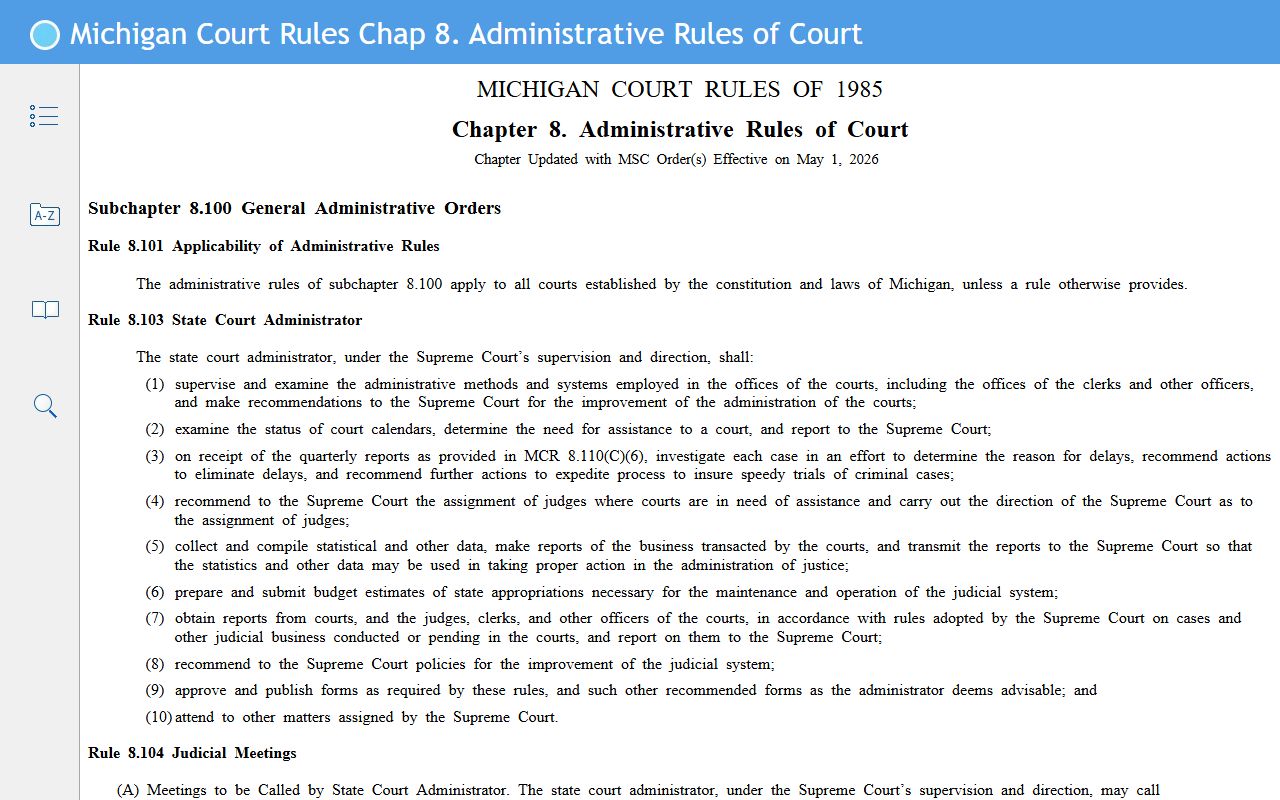
Chapter 8 of that rule book is the authority that shapes what a Barry County clerk can hand over at the counter.
Two more statutes round out the framework. The exemptions list at MCL 15.243 shields several categories of personal and sensitive information from release. Courtroom access itself rests on MCL 600.1420, which says Michigan courts sit publicly, subject to statutory exceptions. Together these define what stays open and what a redaction removes.
The exemptions live in the Michigan FOIA text, published at the exemptions section.
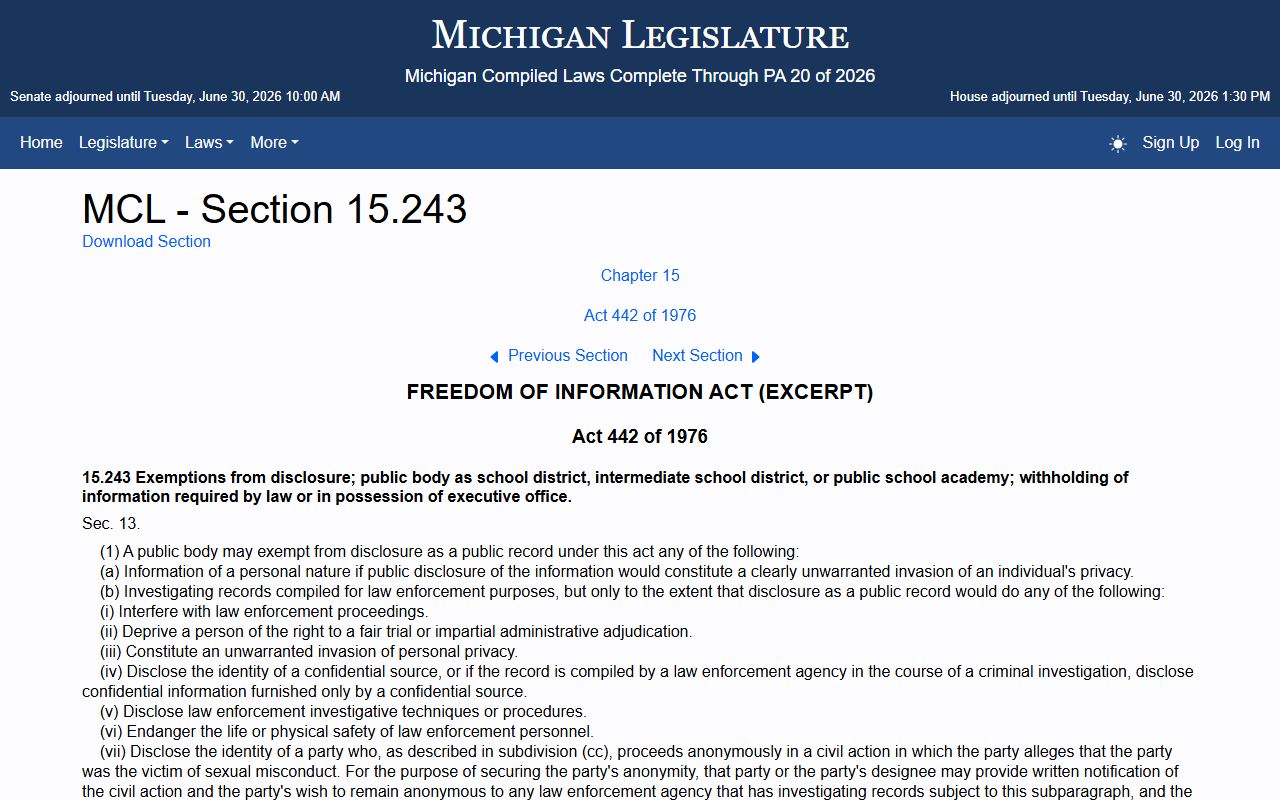
Those exemptions explain why a Social Security number or a minor's identifying data is withheld even from an otherwise open file.
The legislature also hosts the full Michigan FOIA act text.
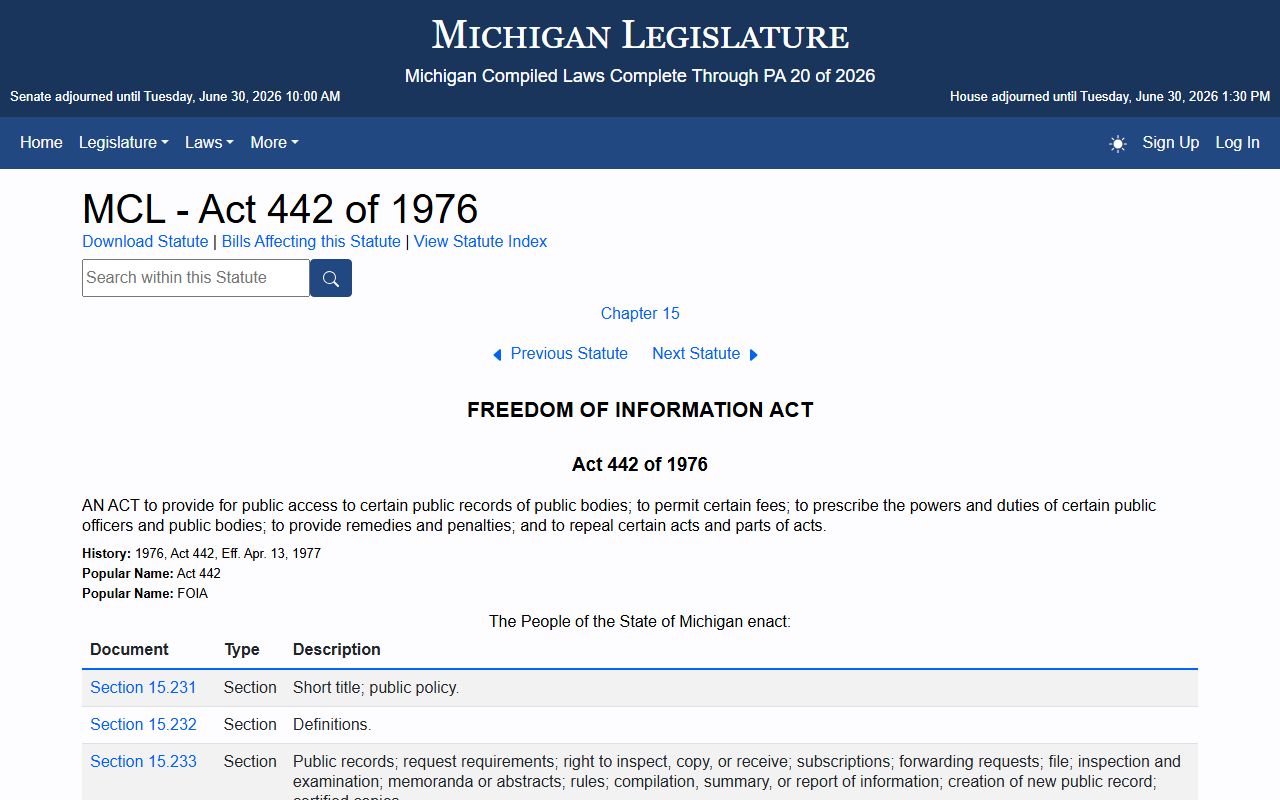
That act is the fallback authority when a record is held outside the digitized case-search window and must be requested in writing.
Note: Anyone may search Barry County case files, but court rule and FOIA exemptions still bar release of confidential Friend of the Court, juvenile, and sealed material.
Sealed and Confidential Barry County Records
A predictable set of files sits outside normal public search. Juvenile case records are strongly restricted, and some are open only by court order. Sealed and expunged records drop out of the public index once a court sets a conviction aside. Adoption files are usually sealed or heavily restricted rather than treated like ordinary civil cases. Mental health commitment matters in probate carry narrower access than regular civil files. Personal identifiers, such as Social Security numbers and financial-account data, are redacted or withheld under court rule and FOIA exemptions.
Getting into a restricted file takes a legal step, not a stronger search. For a set-aside, confirm the conviction qualifies under Michigan's expungement law, check the waiting period, and file in the correct court with the filing fee unless it is waived. Notify the parties the statute or local rule requires. If a judge grants the request, the conviction is set aside, though the underlying court record is not erased from existence. Traffic offenses and some misdemeanor categories follow separate rules, so one expungement path does not fit every conviction.
In-Person Barry County Record Requests
When a record is older, certified, or missing from the online tools, the County Clerk is the counter to visit. The office is on Floor 1 of the Barry County Courthouse in Hastings and serves as the fallback for court orders, certified copies, and files the search portals do not expose. Bring the case number if you have it, along with a photo ID, and be ready to pay any copy or certification fee at the counter. The office closes for lunch, so plan a visit around its posted counter hours.
Barry County Clerk
220 W. State St.
Hastings, MI 49058
269-945-1285
Mon-Fri 8:00 a.m. to 12:30 p.m. and 1:30 p.m. to 4:45 p.m.
For deeper case history, the clerk works alongside the online record system rather than replacing it. The searchable dockets stay in MiCOURT, so many visitors check the file first through the county court dockets path and then request only the certified copies they need at the counter. That order keeps counter time short and avoids paying for pages you can already read online.